Vietnamese E-9 workers in Korea: how to get back your pension contributions when you return home (반환일시금)
Vietnamese workers with E-9 (EPS) status who have paid into Korea's National Pension (국민연금) can receive back all the contributions they paid plus interest when they return home — called 반환일시금 — even though the Korea–Vietnam social security agreement currently applies only to the exemption from double contributions.
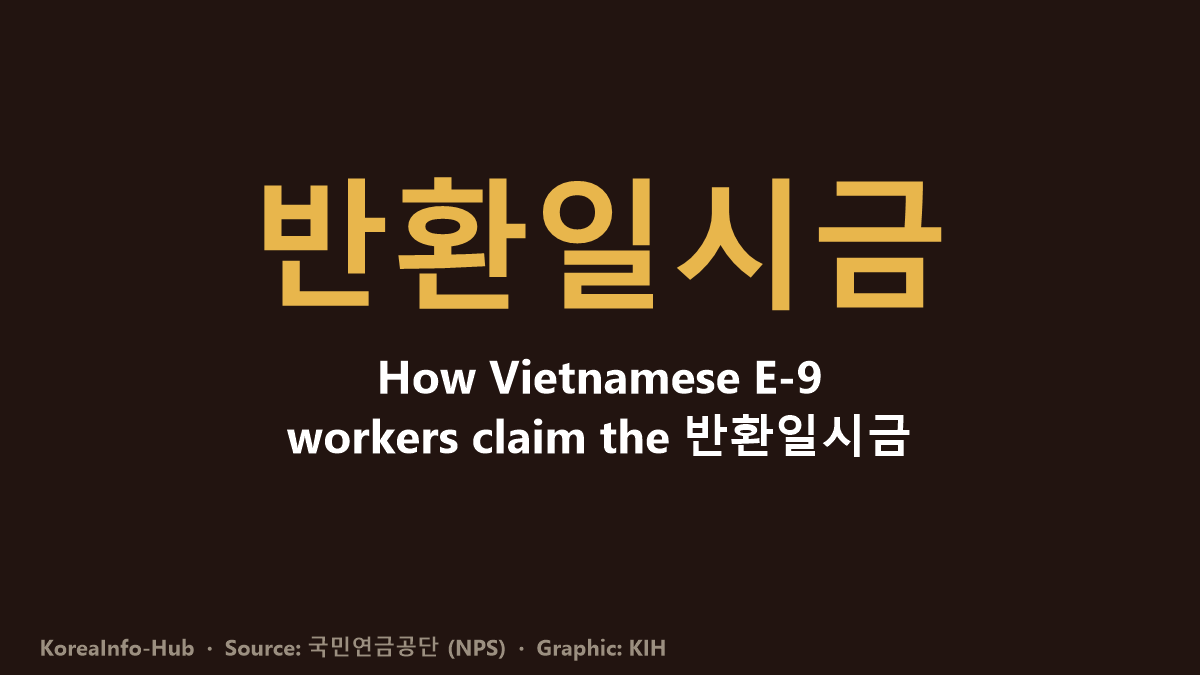
If you are a Vietnamese worker currently or formerly employed in Korea on an E-9 (EPS — non-professional employment) visa and have had contributions to the National Pension (국민연금) deducted from your pay, you have the right to receive back all the premiums you paid (both the portion deducted from your wages and the portion paid by your employer) plus interest when you leave Korea permanently — called 반환일시금 (lump-sum refund). This right applies according to your visa status and does not depend on whether Vietnam has an agreement with Korea.
The Korea–Vietnam social security agreement (in force since 01/01/2024) currently applies only to the exemption from double insurance contributions for workers dispatched for a limited period (파견) and certain locally hired workers between the two countries. The totalization of insurance periods used to calculate monthly pensions is suspended, pending Vietnam's issuance of corresponding domestic legislation. However, under the rules of Korea's National Pension Service (NPS), holders of an E-9 visa are entitled to receive 반환일시금 regardless of the agreement, whether or not the agreement still lacks the totalization part.
The amount you receive = total contributions paid + interest at the 3-year fixed-term deposit rate announced annually by the Ministry of Health and Welfare, calculated from the month after the month of payment to the month the insured status was lost (2026: 2.2%, which may change from year to year). The claim must be made within 5 years from the date you become eligible to receive it; only where the reason for receipt is reaching age 60 (the age at which 반환일시금 is paid) arising on or after 25/01/2018, the period is 10 years; in the case of returning home it remains 5 years.

How to receive it: (1) At a National Pension Service branch before you return home — bring your passport, ARC, flight ticket (departure expected within 1 month) and details of a bank account in your name (in Korea or in Vietnam) to receive the money after your departure is confirmed; (2) Receiving the money at Incheon Airport (공항지급) — you do not apply at the airport: within 1 month before your flight date you must still apply in advance at a branch or NPS counseling center (with your passport, ARC, flight ticket and a backup account), and your employer must have filed the resignation report (퇴사신고) no later than the day before your flight; on your departure day, go to the NPS Counseling Center counter at Terminal 1 (1st floor, 09:00–18:00) to receive the payment decision, then exchange the money at the Woori Bank counter in the airport; payment is made only in foreign currency (16 currencies, no won); available only for weekday flights (T1 departures 10:30–24:00, T2 11:00–24:00), not on Saturdays, Sundays, public holidays or the last working day of December.
If you hold another visa (E-7, D-x, F-x...), you should call the National Pension Service hotline 1355 (from abroad: +82-63-713-6900) to confirm your own conditions, because the rules apply according to nationality and the specific residence status. Note: according to the NPS, E-8 seasonal workers (계절근로) are currently not eligible for 반환일시금. Keep your insurance contribution records and payslips in full throughout your employment so that the 반환일시금 procedure goes smoothly when you return home.
🏛 Official sources
- National Pension Service (국민연금공단, NPS) ↗ — agency that administers and pays the 반환일시금
- Korea–Vietnam Social Security Agreement (NPS) ↗ — content of the bilateral agreement