연말정산: what year-end tax settlement means for foreign workers and how it works
If you are an employee in Korea, every year your company carries out 연말정산 — the year-end income tax settlement — to recalculate the tax you actually owe. Understand the process, the deduction documents, and the flat tax rate option for foreigners.
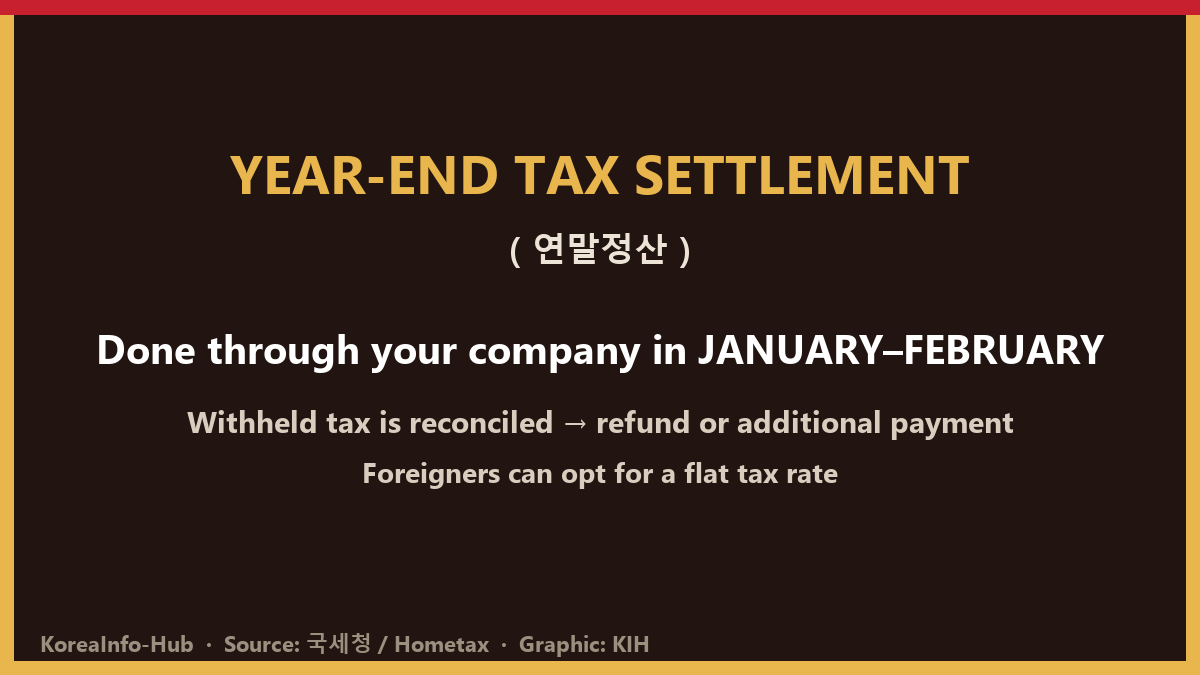
연말정산 (year-end tax settlement) is the recalculation of an employee's income tax for the previous year: the tax provisionally withheld each month is compared with the tax actually owed. If you overpaid, you get a tax refund; if you underpaid, you must pay the difference. This also applies to foreign employees working in Korea.
Timing: usually carried out in January–February each year, handled by the company (HR/accounting department) on behalf of employees, based on the previous year's data. (Self-employed people/freelancers file under 종합소득세 in May — that is different from 연말정산.)
Common deduction documents: medical expenses, education, credit/debit card spending, housing rent (in some cases), donations, dependents... Many items can be looked up and downloaded directly from the 연말정산 간소화 service on Hometax (hometax.go.kr).
Option for foreigners: foreign workers may be allowed to choose a flat tax rate instead of the progressive tax schedule — this can be advantageous depending on your income level. Check the current conditions and rate with 국세청 (the National Tax Service) or on Hometax before choosing.
Tips: keep all supporting documents throughout the year; ask your HR department about the document submission deadline; if your situation is complicated (multiple income sources, arrived mid-year), consider consulting a tax professional.
🏛 Official sources
- 국세청 (National Tax Service) ↗ — Korea's National Tax Service
- Hometax ↗ — electronic tax portal — 연말정산 간소화 service
See jobs & economy guides
Open →